After the surge of increasingly bigger displays wihtin cockpits, the screens mutliplication in automotive broadly tends to stabilize as several factors came across the industry to deal with this phenomenon.
Firstly, reducing distraction is one of the main issue OEMs are trying to alleviate as mutliple display locations have proven drivers to encounter less focus on the road, as they require more time to operate functions.
Second, the stand-alone CID with complex UI tends to be less relevant since its structure leads to the dependency of the latter to operate any function of the car, leading to standardization of interiors with too much homogeneous dashboards.
Finally, wide flat display panels are no longer seen as innovative and with high percieved value. Instead, end-users are more favouring alternation of different materials and textures synonym of more high-end finish.
In order to tackle those aspects of distraction, HUD has been the main driver in the revamp of cockpits, where displays are not allocated the same space than some years ago. Also, the enhancement of new projection surfaces is the trend getting the most significant momentum currently, mainly through panoramic HUDs, and where the flatness of the displayed image is no longer a constraint. In this way, the Reflective Blade brings its unique features to act as an innovative projection and magnification panel, to break free from existing constraints of traditional displays, and to set new standards of p-HUD integration.
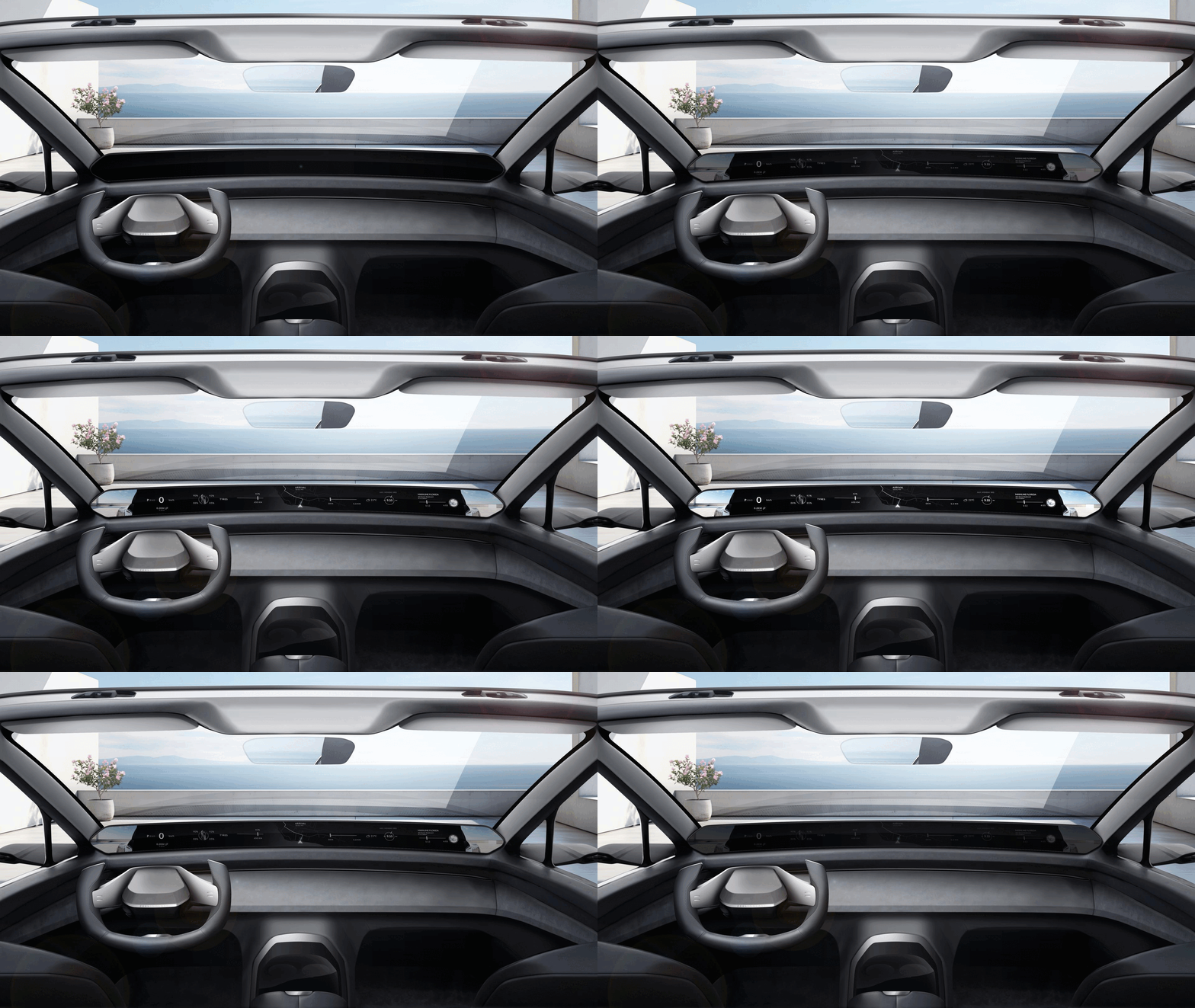
Even if curved displays have been introduced successfully within cockpits, providing the driver with a more immersive experience, their presence tends to rely more on the OEM strategy, rather than on its no brainer nature. Also, the cost of a curved display is way higher than a flat panel, leading to the arbitration of choosing between flat or non flat screens. However, it is precisely the same happening with p-HUD, with some pioneering brands leading the trend, and others being more careful about their perceived value, usefulness and adoption level.
Consequently, projection broadly stated, appears to be the most fexible and cost-effective solution as the projection surface can be more easily adapted than the light source in terms of curvature and size. Indeed, this configuration opens up the way the projected content can be displayed to occupants, while glass will act as a crucial element allowing a crysal clear render, stylish appearance and seamless integration. From that standpoint, calibration and magnification are key parameters to be finetuned in order to develop a long-lasting solution for cockpits considering exterior varaibles like lighting and weather consitions. This is why the Reflective Blade for HUD is currently the most advanced solution addressing this display setup, bringing a pioneering vision of the cockpit of the future.
For more information about our Reflective Blade for cockpits, don’t hesitate to contact us.